Wednesday, July 20, 2011

Man It's Hot

It's not only hot but it's dry as well. I have only had 1 7/8" of rain here since the first of the year. I'm praying that the well holds up so we have water to the house. Having the 24,000 gallon rain water collection system makes me feel better about watering the plants. This being the first year to really use it I haven't been watering any more than normal. Normal for me is letting a lot of plants die as I am a real water miser. I am down to four tomato plants left and one still puts on a tomato every week or so. That particular plant is in the shade from 10:00 until 6:00. I am wishing I had more shade and am thinking about shade cloth for next year now.

I finally decided to get a ladder and take a look inside the water tanks and see how much water I had left. They were not full at the first of the year but were very close.

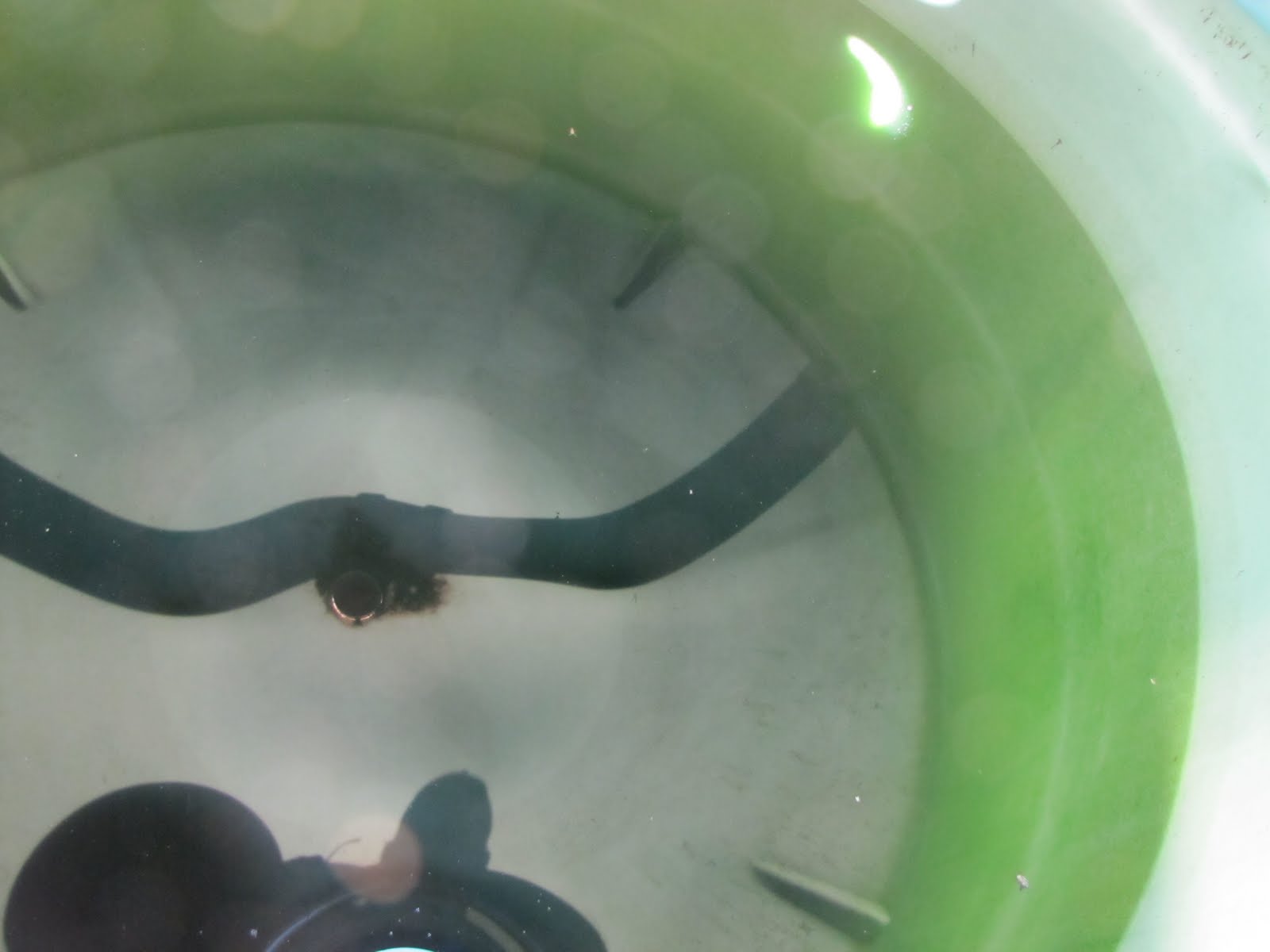
This picture may not make much sense but it is looking down into the tank through the top portal. You can see the reflection of the pipe running across the top of the tank and the hole the water flows in. The little dark place on the bottom is dirt that has washed in. Not much at all, it tells me my home made roof washer system is working well. It appears they are down about one third as the water level is on the 2000 gallon mark. Times eight tanks, I have 16,000 gallons left and have used 8000. I feel better now.

I have been building a metal building lately and working in the heat all day. I just don't feel like working in the garden in the evenings. I may pull a weed here, prune a little there but I'm watering every where. With this kind of heat I'm just trying to keep plants alive until fall now. It is a learning experience though. I know now what plants will hold up and maybe even bloom a little.

I always have zinnias in my garden. They are descendants of plants that were seeded years ago. It may be time to buy new seeds as they seem to be displaying with less and less color every year. They don't mind the heat though, if they get a little water. Unfortunately they never seem to come up where I want them to. These came up in a tomato cage. The tomato didn't make it but they did.

While neither Lyn or I, are big fans of egg plant, I always plant a couple plants for my neighbor. He doesn't garden but loves egg plant. He swears they are the best he's ever eaten. I don't really know what kind they are. I just buy what ever I can find at the nurseries. I just don't tell him that, he thinks they are some special kind.

I got lucky this year and got a great heat tolerate plant from my buddy, Philip, at ESP. It was just a little thing in the spring when I got it but has grown well and is about to bloom despite being eaten down to the ground by a rabbit once. I don't know the name for sure as I think Philip is pulling some good ol' Scottish humor on me about the name. When I mention to him that the Pearls of Opar is doing well, he says no, it's Jewels of Opar. If I say Jewels of Opar then he says no, it's Pearls of Opar. I am fairly certain that it is one of those two. Either way it is a great hot weather plant and doesn't even require that much water to do well. I think I picked the perfect place for it if the rabbit stays away.

While working on a ranch last year I happened to notice a tiny, purple, little bloom on a plant by the ranchers drive way. With the bloom and the spiky little leaves, it was enough for me to tell that it was a Wooly Ironweed. I've wanted one for a long time and asked the rancher if I could dig it up. In a typical rancher response he said "You want to dig up a weed? Sure, go ahead and dig it up if you want it. I think there might be a few more down in the lower pasture if you want some more." I could tell it had been mowed over it's entire life. It is a happy plant now and has just started to bloom.

Temperatures over a hundred for months, like we have had this year, will take it out of most plants, but if a person has ponds and pond plants, then you know you will have plenty of green in the garden.

The upper pond has just about been covered in Lotus and Arrowhead.

The middle pond has Pickerel Weed and Umbrella plant with miniature lilies in it.

The big pond has lotus, lilies and Red Stemmed Thalias. The Thalias are a little behind this year and are just now big enough to start showing the red in their stems.

There have been more blooms on the lotus than in any year in memory.


As the leaves die they make for interesting patterns in the garden.


At least I have some green even if I don't have many blooms.


Wednesday, May 11, 2011

Garden Metalwork

Metal worker by trade and gardener by hobby, it's nice for me when the two come together. It seems metal just goes well in the garden, the lawn or the patio. I always consider myself lucky when I get those kinds of jobs because I just enjoy it more and maybe because I have an artistic yearning to satisfy. While a gardener can get a lot of metal work from nurseries, it is usually cheap, poorly made stuff from Mexico or China. Some people have their own ideas of what they want and need to have it custom built. I've gotten to do a couple of jobs like that recently and both of the customers were great gardeners as well.

One was just a simple arch over a gateway. The house is just a beautiful old ranch house that has been restored. The lady that lives there was raised in the house but has only been living back there now for a few years.
She plans on having vining roses climb up and over the archway. It should look just stunning.

There are flower beds behind the snort rock wall all the way around the yard with roses staggered through them.

She showed me pictures of them from last summer and it was gorgeous. This was in early March and I have an invite to go back and see them all in bloom. Can't wait.

The next job was a gate for a deck. The lady that lives there has beautiful gardens as well as plants in pots just every where. She was worried about accidentally falling down the stairs while tending her potted plants on the deck. There really wasn't that much room to move around on that part of the deck. She is in my native plant club and had seen another gate I had built for some one in the club and wanted hers to be similar.

The gate turned out just like she wanted it and should fit it's function well.


After installing the gate, I was privy to a stroll through her gardens, and lovely gardens they were.While it was not a mature garden, as she has only lived here two years, it was still beautiful.


 She has a stunning Peggy Martin rose that sprawls along her fence. You can see the first pink blooms, a promise of the explosion that is about to come. I must have one.
There is still some grass in the front yard but it is short lived. The crew to remove it was arriving as I was leaving.
I like leaving little surprises when I do these kinds of jobs. I left a grasshopper at the first house and a lady bug at the last. Both ladies found them within a few days and called to say what a nice surprise it was.
 

I haven't posted in a while. The gardening just about came to a stand still. Lyn fell and broke her arm....bad.
 
A few days afterwards, her left leg started to give her some intense pain as well. After an MRI, it was discovered she has five bulging discs as well. I've had to do a lot more than normal around here. I didn't realize how much she takes care of until I had to start doing a lot of it. That and going to a lot of doctors has put the gardening on the back burners, but I'm getting back to it now.

Sunday, April 3, 2011

Wandering Buffalo

Agnes Plutino was one of the first people I met when I joined the Georgetown chapter of the Native Plant Society. She certainly must be one of the nicest people I've ever met. She is also the most knowledgeable person on native plants that I know of. Last year her good friend and editor of our news letter, Christene Powell called me up and wanted me to help her with a birthday present for Agnes.

While Agnes' whole yard is planted to natives with blooms of every imaginable color, her back pasture has been turned into a prairie. I mean the kind of prairie that was here before most of it was destroyed. There are grasses of every sort along with all the prairie flowers. I mean a real prairie. However the one thing she was missing in a real prairie was a buffalo.

This is where it gets good. Christene wanted me to build a buffalo like one she had seen some where. It was cut out of a sheet of metal and had legs that drive in the ground to hold it up. It was almost life size. I would do the work for free and Christene would buy the metal. It came out very nice and Agnes was thrilled with it. Now her prairie was complete. Well, for a while it seems.
Some low lifes have stolen the buffalo. Now Agnes' prairie is incomplete again. Why would any one steal a sheet metal buffalo? If any one sees this buffalo any where, would you please get in touch with me.


Friday, March 25, 2011

Bugs

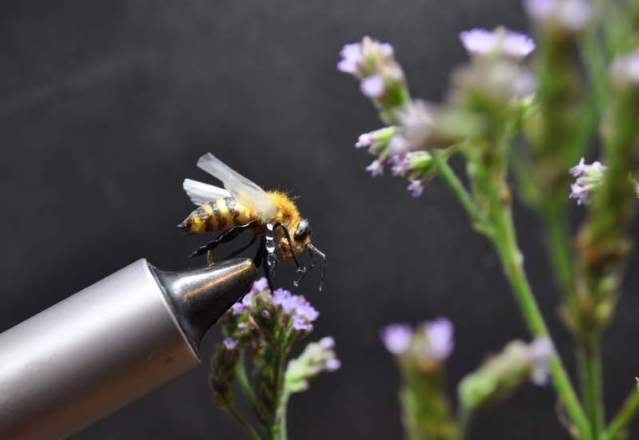
While most gardeners are always on the look out for bugs, fly fishers are as well. Gardeners try to determine if they are good or bad, anglers try to determine if they would be fish food. The very astute gardeners will observe them, take closeup pictures of them [ESP], and learn about them. If they are good, whoo hoo, if they are bad, squish. Astute fly fishers will observe them, take close up pictures of them and learn about them. If they are bad you just toss them, if they are good, [aka fish food] then you copy them.

There are two lines of thought on making bugs that catch fish. Some tie the bugs to sorta look like the bug they want to fish with. Fish aren't too smart and that is really good enough. However there is another group of fly tiers that fish with bugs that are realistic looking.

I know several people that do this and their bugs are just unbelievable. They are just so realistic looking and they also are tough. They will hold up to getting cast back and forth in the air as well as getting wet and getting mauled by fish.

I thought it would be interesting to show some pictures to gardeners of some of the bugs that these guys make. They are unbelievable in their looks as well as being fishable. I got most of these pictures off of flytyingforum.com if anyone wants to check them out.


Saturday, January 29, 2011

Important Native

While hunkered down under a piece of farm equipment I was supposed to repair, the rancher that owned it was bent over, looking into the grass. I thought he had lost something for a moment but he looked up and had a little smile on his face. He looked over at me and casually said that the wildlife would get through this winter OK. I asked him how he knew and he pointed down to the ground and said "Filleree, it's every where this year and doing right well".


Filleree, as the old rancher pointed out, is probably one of the most important plants in the hill country where wild life is concerned. I'm sure he also knew that his cattle as well as the neighbors Barbado sheep would make good use of it as well. The native plants in the hill country of Texas are notorious for having very low protein values with very few even over 10%, and that is when they are at their prime. In the winter time they are closer to zero. Filleree has a protein content of over 17%, even in the winter, as that is when it is young and growing. That protein will be utilized by deer, turkeys, rabbits and other wildlife to keep them healthy through the rigors of the winter when many other food sources for these animals are lacking or gone altogether.


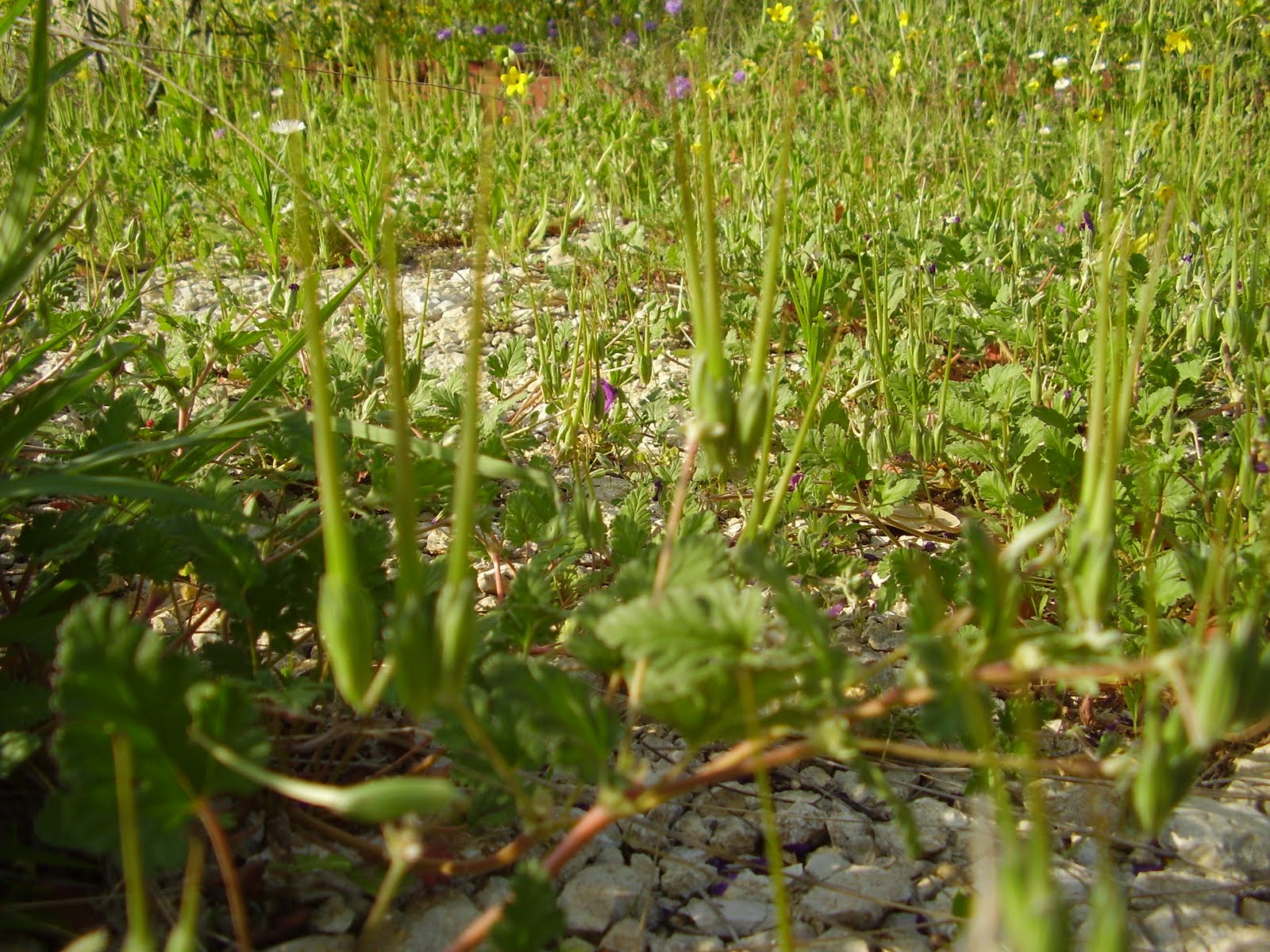
Such an important plant and you would have to look closely to even see it, growing flat to the ground. It's really easy to see though, if you know what to look for. During the winter many of it's tiny leaves are crimson red instead of green, and show up easily.


While the old rancher knew and appreciated the filleree for it's benefit to the animals, he could have cared less about the show of violet blooms that all native plant people would recognize as Stork's Bill. It's not one of the big show natives, with the blooms only hanging around for less than a month, but while it's here, it's here with a bang.

All those blooms will make the very thing that Stork's Bill is named for, the seed pods. They look just like a stork's head and bill.


So, whether you call them Filleree or Stork's Bill, it's a very important plant to have. And just how many plants can be this important and be this beautiful as well?